The Connected Building: Why Life Safety Must Integrate With Modern Systems
The Connected Building: Why Life Safety Must Integrate With Modern Systems
In our previous article, Life Safety Data: The Next Frontier in Emergency Response, we explored how modern systems are beginning to deliver more than just alarm signals — providing valuable data that can support faster and more informed emergency response. In this edition, we’ll examine how the new connected building effects the evolution of life safety systems?
But delivering better data is only part of the transformation.
To fully realize the potential of modern life safety systems, another critical shift must take place:
Life safety systems must become part of the connected building.
This represents one of the most important changes shaping the future of building life safety in Ontario.
The Rise of the Connected Building
Today’s commercial buildings are no longer made up of isolated systems.
Instead, they operate as integrated digital environments, where multiple technologies work together to support operations, security, and occupant experience.
Modern buildings commonly include:
- Access control systems
- Video surveillance platforms
- Building automation systems (BAS)
- Energy management systems
- Remote monitoring platforms
These systems are often interconnected, providing centralized visibility and control through unified interfaces.
However, life safety systems — particularly fire alarm monitoring — are frequently still treated as standalone infrastructure.
The Problem With Isolated Life Safety Systems
When life safety systems operate in isolation, valuable opportunities for coordination and efficiency are lost.
Disconnected systems can lead to:
- Limited visibility across building operations
- Manual workflows between systems
- Delayed response coordination
- Inconsistent data sharing
In critical situations, these gaps can create unnecessary friction during emergency response.
As buildings become more complex, the need for integrated systems becomes increasingly important.
What Integration Looks Like
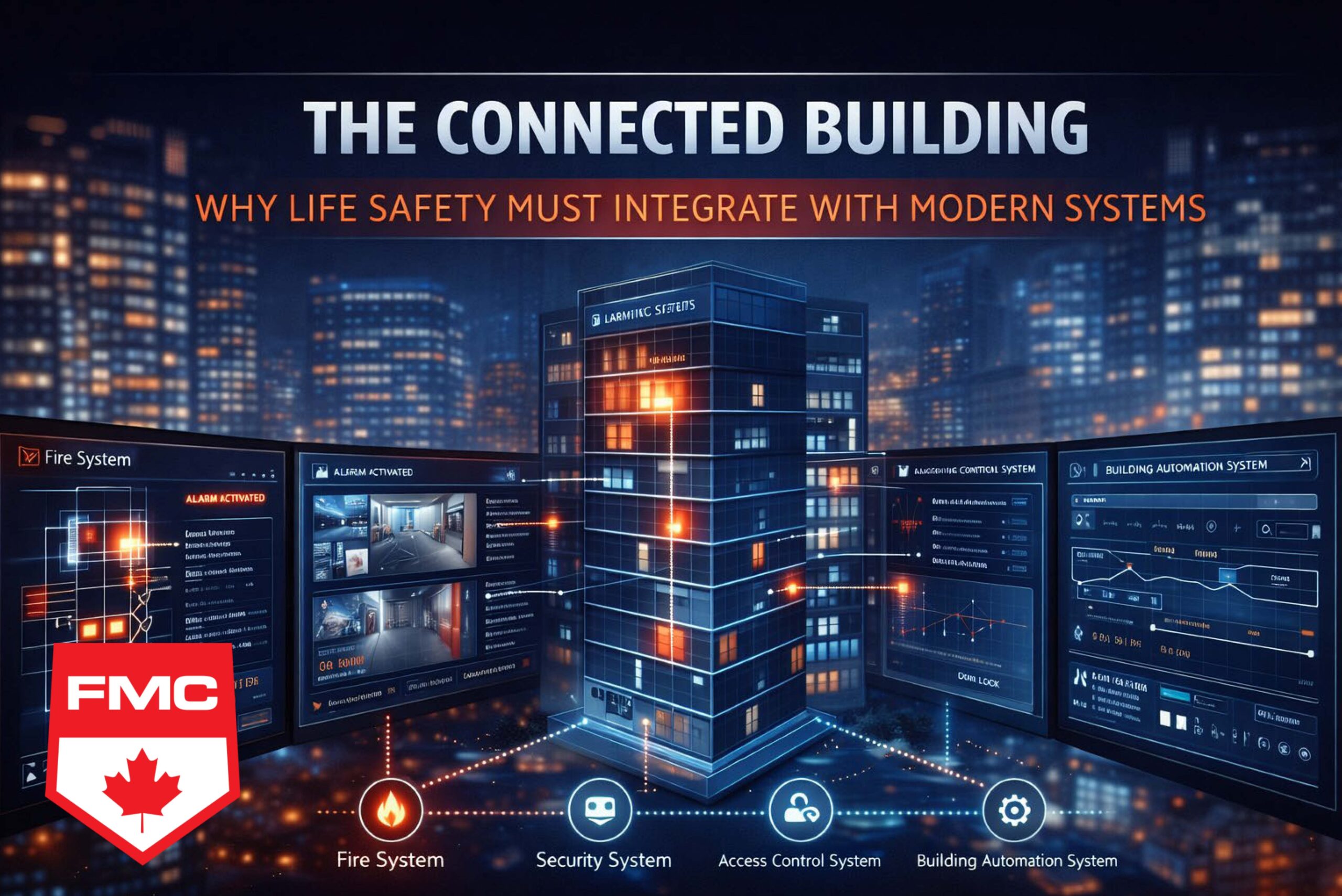
Integrated building systems allow multiple technologies to communicate and share information in real time.
In a connected building environment, life safety systems can work alongside:
- Access control — unlocking doors or restricting access during an event
- Security systems — providing visual verification through surveillance cameras
- Building automation — controlling HVAC systems or smoke management
- Notification systems — delivering coordinated messaging to occupants
This level of integration helps create a more coordinated and effective response during an emergency.
Improving Response Through Integration
When systems are connected, operators and responders can access a more complete picture of what is happening inside a building.
For example, an integrated environment may allow:
- Real-time visibility into alarm location and device activation
- Immediate access to video feeds from affected areas
- Automated control of building systems during an incident
- Centralized monitoring across multiple systems
This enhanced visibility can help reduce response times and improve decision-making under pressure.
The Role of Infrastructure
Integration is not just about connecting devices — it requires the right underlying infrastructure.
Life safety platforms must be designed to:
- Support modern digital communication standards
- Integrate with third-party systems
- Provide reliable and secure data transmission
- Maintain compliance with applicable standards
Without this foundation, integration efforts can be limited or unreliable.
This is why modern life safety infrastructure is increasingly being designed as part of a broader building ecosystem, rather than as a standalone system.
Maintaining Compliance in an Integrated Environment
As systems become more connected, maintaining compliance with life safety standards remains critical.
In Ontario, standards such as CAN-ULC-S561 continue to define expectations for fire alarm monitoring and signal processing.
Integration must be implemented in a way that supports — not compromises — these requirements.
This means ensuring that life safety systems remain reliable, supervised, and capable of delivering alarm signals without delay, even within a highly connected environment.
The Future of Connected Life Safety
The shift toward integrated building systems is accelerating.
As technology continues to evolve, life safety systems will increasingly become part of a unified building platform — one that supports not only detection and notification, but also coordination, intelligence, and operational efficiency.
This transformation is redefining how buildings are designed, managed, and protected.
For building owners, integrators, and consultants, understanding how life safety fits into this connected ecosystem will be essential for future-ready building design.
Next Week: From Monitoring to Intelligence
Over the course of this series, we’ve explored how life safety infrastructure is evolving — from legacy communication systems to modern digital networks, and from simple signals to data-enabled platforms.
In our final article, we look ahead to what comes next.
We will explore how life safety systems are evolving beyond monitoring — toward intelligent platforms that may help predict risks, improve response, and transform building safety.
Part 5: The Future of Life Safety in Ontario — From Monitoring to Intelligence
About Fire Monitoring of Canada
Fire Monitoring of Canada provides ULC-listed fire alarm monitoring and life safety services for commercial, institutional, and multi-residential buildings across Ontario.
Through modern monitoring infrastructure and the OPEN ACCESS™ platform, FMC supports faster, more reliable fire alarm signal delivery designed for today’s connected buildings.