From Dial-Up to Real-Time: The Evolution of Fire Alarm Signal Delivery
From Dial-Up to Real-Time: The Evolution of Fire Alarm Signal Delivery
In our previous article, The Silent Risk in Modern Buildings, we explored how modern buildings are becoming increasingly connected — yet many life safety systems still rely on legacy infrastructure. In this week’s article, we are going to focus on the evolution of fire alarm signal transmission.
As we try to understand why this gap matters, it helps to look at how fire alarm monitoring technology has evolved over time.
The way alarm signals travel from a building to a monitoring centre — and ultimately to emergency responders — has changed dramatically over the past several decades.
These changes are shaping the future of fire alarm signal transmission in Ontario and redefining what reliable life safety infrastructure looks like.
The Early Days of Fire Alarm Monitoring
Historically, fire alarm systems transmitted signals using dedicated telephone lines.
When an alarm activated, the fire alarm panel would dial a monitoring centre through the public switched telephone network (POTS). The receiving centre would then verify and relay the alarm to emergency responders.
This approach served the industry for many years and became the foundation of central station monitoring.
However, these early communication methods were built for a very different technological environment — one where buildings were far less connected and network reliability expectations were much lower.
The Limitations of Dial-Up Communication
While dial-up communication was once the standard, it has several limitations in today’s connected world.
Traditional phone-line monitoring can be vulnerable to:
- Line cuts or service interruptions
- Limited supervision of communication pathways
- Slower signal transmission
- Dependence on aging telecommunications infrastructure
As telephone carriers gradually retire copper-based networks, these limitations are becoming even more apparent.
For building owners and life safety professionals, this transition has created a growing need for more resilient communication methods.
The Shift Toward Digital Communication
Over the past two decades, the life safety industry has increasingly adopted digital communication pathways.
Modern fire alarm systems can now transmit signals using:
- Internet Protocol (IP) networks
- Cellular communication pathways
- Redundant multi-path transmission
These technologies allow alarm signals to travel faster and more reliably while providing continuous supervision of communication channels.
Rather than relying on a single pathway, modern systems can transmit signals across multiple networks simultaneously — helping ensure the signal reaches the monitoring centre even if one path fails.
Why Redundancy Matters
In life safety systems, redundancy is critical.
When a fire alarm activates, there is no margin for failure. The signal must reach the monitoring centre quickly and reliably.
Modern communication designs often combine multiple pathways — typically IP and cellular — to create a resilient signal delivery architecture.
If one communication channel is interrupted, the secondary pathway continues to deliver the signal.
This approach significantly improves the reliability of fire alarm monitoring and helps reduce the risk of communication failures.
The Role of Monitoring Centres
Once the alarm signal leaves the building, it is received and processed by a monitoring centre.
In Canada, many life safety monitoring operations align with standards such as CAN-ULC-S561, which defines operational requirements for fire signal receiving centres.
These standards address critical aspects of signal handling, including:
- Signal processing procedures
- Operator training
- Redundancy and reliability requirements
- Documentation and auditing
Modern monitoring centres are designed to process signals rapidly and ensure emergency responders are notified without delay.
The Modern Signal Path
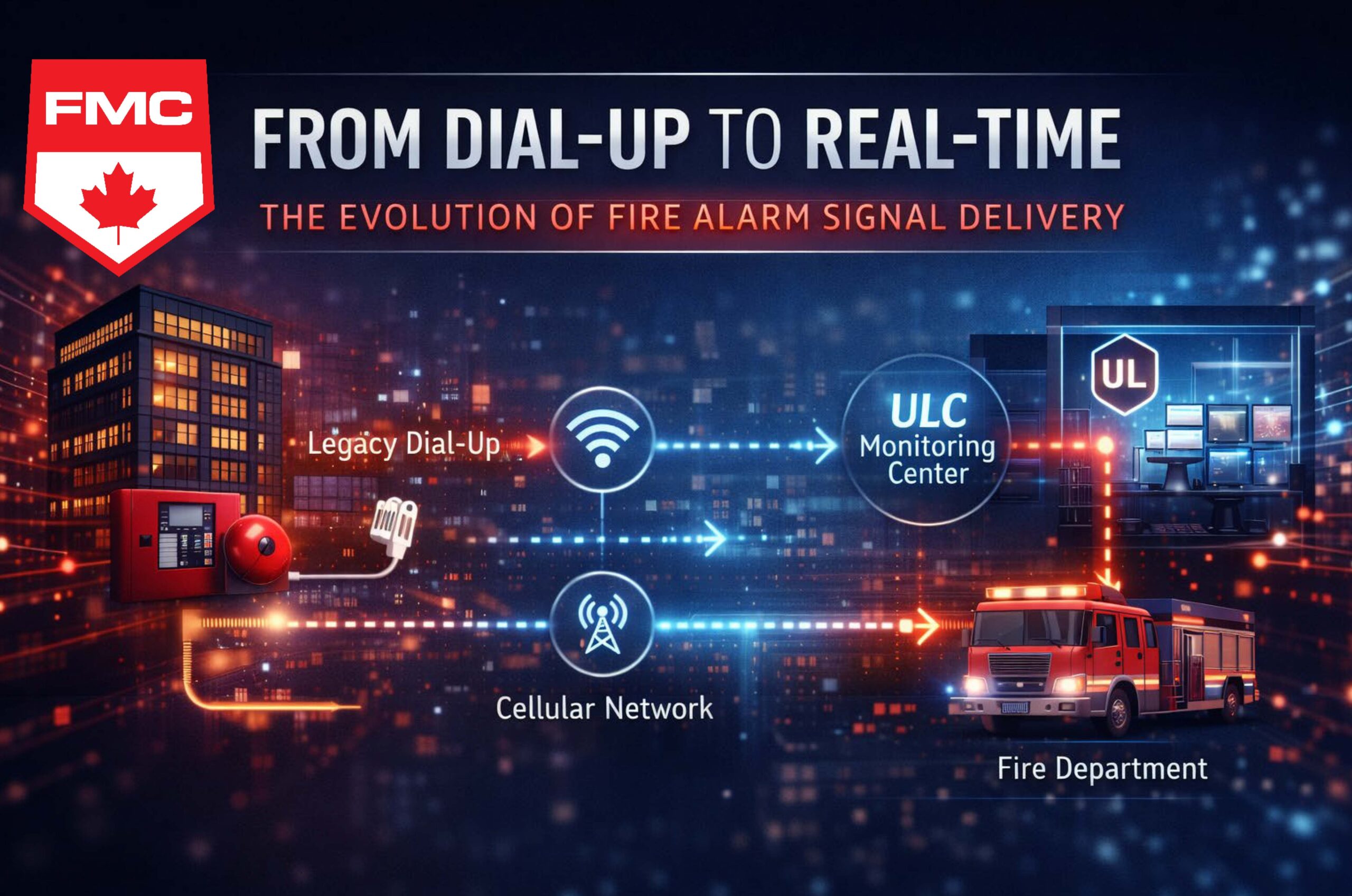
Today, a modern fire alarm signal path typically looks very different than it did decades ago.
Instead of relying on a single telephone line, signals may travel through multiple digital networks before reaching a monitoring centre.
A simplified signal path may include:
- A fire alarm panel detects an event
- The signal is transmitted through IP and cellular communication pathways
- A monitoring centre receives and processes the signal
- Emergency responders are notified
This modern communication architecture helps improve both speed and reliability — two factors that are essential for effective emergency response.
Preparing for the Future of Life Safety
As buildings continue to adopt smart technologies and connected infrastructure, life safety systems must evolve as well.
The transition from dial-up communication to modern digital networks represents one of the most important shifts in the life safety industry.
It is also laying the groundwork for the next generation of life safety platforms — systems that will deliver more than just alarm signals.
These platforms will increasingly support faster signal transmission, enhanced monitoring capabilities, and new forms of building intelligence.
Next Week: How Life Safety Data Is Transforming Emergency Response
Traditional fire alarm signal transmission typically provide limited information — often little more than the fact that an alarm has activated.
But emerging technologies are beginning to change that.
In the next article in this series, we explore how life safety data is transforming emergency response and how modern platforms may provide first responders with valuable building intelligence before they even arrive on scene.
Part 3: Life Safety Data — The Next Frontier in Emergency Response
About Fire Monitoring of Canada Inc.
Fire Monitoring of Canada Inc. provides ULC-listed fire alarm monitoring and life safety services for commercial, institutional, and multi-residential buildings across Ontario.
Through modern monitoring infrastructure and the OPEN ACCESS™ platform, FMC supports faster, more reliable fire alarm signal delivery designed for today’s connected buildings.