The Future of Life Safety in Ontario: From Monitoring to Intelligence
The Future of Life Safety in Ontario: From Monitoring to Intelligence
Over the course of this series, we’ve explored how life safety systems are evolving, with a particular emphasis on the present and future of fire alarm monitoring in Ontario.
We began by identifying the gap between modern buildings and legacy infrastructure. We examined how fire alarm signal transmission has shifted from dial-up communication to digital networks. We explored how data is beginning to enhance emergency response, and why integration is becoming essential in connected buildings.
Now we look ahead.
The next evolution of life safety is not just about monitoring. It’s about intelligence.
Monitoring Was the First Step
For decades, the primary goal of fire alarm systems was clear: detect an event and transmit a signal.
This model defined the life safety industry for generations.
When an alarm activated, the system’s responsibility was to notify a monitoring centre, which would then initiate emergency response.
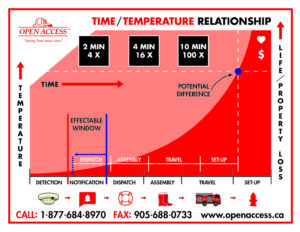
While this approach remains essential, it represents only the foundation of what modern life safety systems can achieve, while also presenting a time delay in the delivery process which is unnecessary based on current technology.
The Shift Toward Intelligent Systems
Today’s buildings generate vast amounts of data.
Sensors, connected devices, and integrated systems are continuously producing information about building conditions, system performance, and environmental changes.
The next generation of life safety systems will increasingly leverage this data to move beyond simple alarm transmission.
Instead of reacting to events, these systems may begin to:
- Provide contextual information about incidents
- Identify patterns and anomalies
- Support faster and more informed decision-making
- Improve coordination between systems and responders
This shift represents a move from reactive monitoring to proactive intelligence.
Faster, Smarter Emergency Response
As life safety systems become more intelligent, emergency response may also evolve.
Future systems could support:
- Enhanced situational awareness for responding crews
- Real-time building data delivered alongside alarm signals
- Improved communication between buildings and emergency services
- More efficient dispatch and response coordination
These capabilities have the potential to reduce response times and improve outcomes during critical events.
The Role of Connected Infrastructure
Achieving this level of intelligence requires modern infrastructure.
Life safety systems must be built on platforms that support:
- Digital communication networks
- Data transmission and processing
- Integration with other building systems
- Scalable and resilient architectures
This is where the concept of life safety as infrastructure becomes critical.
Rather than functioning as isolated systems, future life safety platforms will act as foundational layers within connected buildings and smart communities.
Maintaining Trust, Reliability, and Compliance
As the industry evolves, one thing remains constant: reliability is non-negotiable.
Standards such as CAN-ULC-S561 will continue to play a critical role in defining how life safety systems operate.
Any advancement in intelligence or integration must support — and enhance — the core requirements of:
- Reliable signal delivery
- System supervision
- Operational consistency
- Accountability
The future of life safety will not replace these principles — it will build upon them.
From Systems to Ecosystems
One of the most significant changes ahead is the shift from individual systems to connected ecosystems.
Buildings, monitoring platforms, and emergency response systems will increasingly operate as part of a broader network.
This ecosystem approach enables:
- Seamless data exchange
- Improved coordination across stakeholders
- Greater visibility into system performance
- More adaptive and resilient life safety strategies
As this transformation continues, the boundaries between building systems and emergency response infrastructure will become more closely aligned.
The Future Is Already Taking Shape
Many of these advancements are no longer theoretical.
Across the industry, new technologies and platforms are already beginning to redefine what life safety systems can do.
From enhanced monitoring infrastructure to data-enabled response capabilities, the future of life safety is actively being built today.
For those responsible for building safety — whether owners, integrators, or consultants — staying ahead of these changes will be critical.
A New Standard for Life Safety
The evolution of life safety systems represents an opportunity to rethink how buildings protect people.
The next generation of systems will not simply detect emergencies.
They will help interpret them, communicate them more effectively, and support faster, more informed responses. That is the future of fire alarm monitoring in Ontario.
This is the future of life safety in Ontario.
And it is already underway.
About Fire Monitoring of Canada
Fire Monitoring of Canada provides ULC-listed fire alarm monitoring and life safety services for commercial, institutional, and multi-residential buildings across Ontario.
Through modern monitoring infrastructure and the OPEN ACCESS™ platform, FMC supports faster, more reliable fire alarm signal delivery designed for today’s connected buildings.