Wireless Door Locks and the Evolution of Access Control
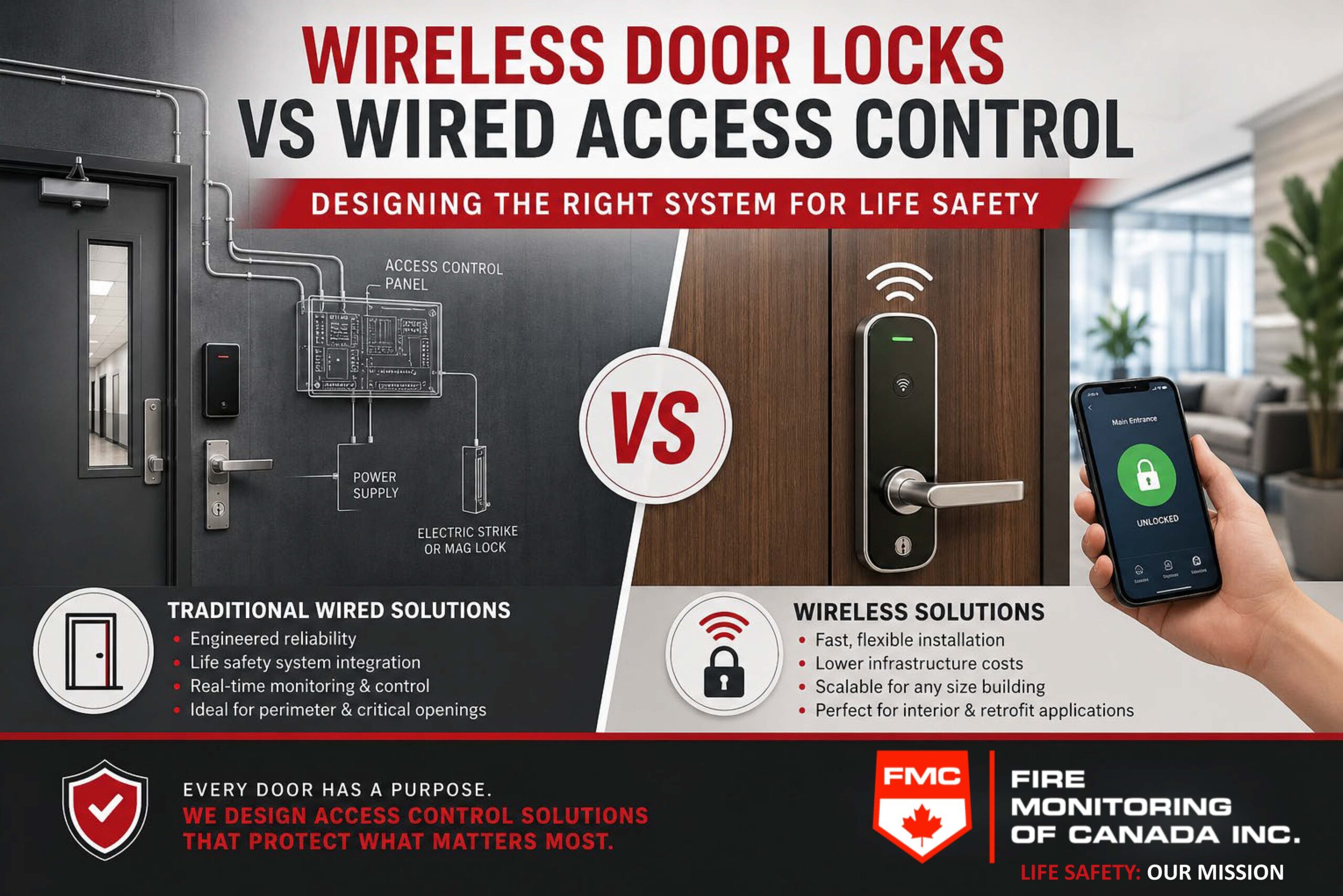
Wireless Door Locks and the Evolution of Access Control
From “Connected” Doors to Offline Intelligence — and Why Design Still Matters
Wireless door locks are rapidly transforming access control systems, changing how buildings are secured, designed, and scaled. For decades, access control was defined by one thing: the door reader.
A credential is presented, a panel makes a decision, and a lock responds. It was structured, engineered, and predictable.
Today, that model is evolving.
Wireless door locks in access control have fundamentally reshaped the access control landscape — not just in how doors are secured, but in how systems are designed, deployed, and scaled. What was once limited largely to hospitality has now expanded into condominiums, schools, healthcare facilities, municipal buildings, commercial properties, and multi-site organizations.
But as the technology evolves, one thing becomes clear:
More options do not simplify access control design. They make it more important to get the design right.
The Rise of Wireless Locks: Flexibility Meets Scale
The growth of wireless and smart locks has been explosive. Global smart lock adoption is accelerating at double-digit rates, driven by demand for convenience, scalability, and integration with broader digital ecosystems.
Wireless door locks in access control have gained traction because they solve problems that traditional access control could not always solve easily.
- Wireless door locks:
- Reduce the need to run wire to every opening.
- Can lower installation costs in existing buildings.
- Make large-scale retrofits more practical.
- Support modern credentialing options, including mobile and cloud-based access.
- Allow more doors into an access control strategy.
From a building owner’s perspective, the appeal is clear:
More doors secured, faster, and with less disruption.
But from a life safety and compliance perspective, the conversation needs to go deeper.
Connected Wireless Doors vs. Offline Wireless Doors
Not all wireless locks operate the same way. One of the most important design considerations is understanding the difference between a connected wireless door and an offline or polling wireless door.
What Is a Connected Wireless Door?
A connected wireless door communicates with the access control system in near real time, typically through a gateway, hub, or network connection.
Connected wireless doors may provide:
- Near real-time audit trails
- Immediate credential updates
- Remote lock or unlock capability
- Remote lockdown functionality
- Integration with broader access control and security platforms
These doors are often better suited for areas where visibility, control, and fast response matter, such as:
- Perimeter doors
- Administrative areas
- Restricted access zones
- High-value storage areas
- Shared amenity spaces
What Is an Offline or Polling Wireless Door?
An offline wireless door operates more independently. Rather than maintaining a constant connection to the access control system, it updates periodically through scheduled synchronization, local interaction, or credential-based data transfer.
Offline wireless doors may provide:
- Reduced infrastructure requirements
- Cost-effective deployment across many doors
- Battery-powered operation
- Local decision-making at the door
- Practical access control for lower-risk interior openings
These doors can be useful in locations such as:
- Interior offices
- Classrooms
- Storage rooms
- Staff-only areas
- Suite or unit doors in multi-residential buildings
The key is understanding that an offline door is not the same as a connected door. It may be effective, efficient, and appropriate — but it does not provide the same level of real-time control.
Where Traditional Wired Access Control Still Wins
Wireless locks have created new possibilities, but they have not eliminated the need for traditional wired access control.
In many cases, a traditional card reader connected to an electric strike, electrified hardware, or mag lock is still the correct solution — and in some cases, it may be required by engineered drawings, specifications, building code considerations, or the authority having jurisdiction.
Traditional wired access control is often still the better choice when:
- Fire alarm integration is required.
- Immediate release is needed during an alarm condition.
- The door requires constant supervision.
- Forced-door or door-held-open monitoring is critical.
- The opening is part of an engineered life safety design.
- High-traffic entrances require maximum reliability.
- Fail-safe or fail-secure operation must be carefully controlled.
- The door hardware must meet specific code or AHJ requirements.
This is where access control design can go wrong:
Wireless locks should not automatically be treated as replacements for wired openings. In many buildings, they are best used as part of a hybrid system.
The Software Race: Integration Is Becoming the Differentiator
Another major shift is happening at the software level.
Therefore, access control software providers are racing to integrate with wireless lock manufacturers. The goal is simple: bring more door types, more credential options, and more hardware flexibility into a single manageable platform.
This race is driven by demand for:
- Unified management of wired and wireless doors
- Mobile credential support
- Cloud-based administration
- Remote user management
- Better reporting and audit trails
- Scalable deployment across multiple buildings
As more platforms expand their wireless lock integrations, the decision is no longer only about which lock to choose. It is about which system can support the building today while still allowing room to grow tomorrow.
It Is Not Just About Hotels Anymore
Wireless locks were once associated primarily with hotels and hospitality environments. However, that is no longer the case.
Today, wireless locks are used across a much broader range of facilities, including:
- Condominiums and multi-residential buildings
- Schools and campuses
- Municipal and city-owned facilities
- Healthcare environments
- Commercial office buildings
- Industrial sites
- Community centres and recreation facilities
The reason is simple: these facilities often have many doors that should be controlled, but not every door justifies the cost, disruption, or infrastructure of a fully wired opening.
On the other hand, wireless locks allow building owners and facility managers to extend access control deeper into the building — not just at the main entrances, but throughout the facility.
Why FMC Takes a Life Safety-First Approach
At Fire Monitoring of Canada Inc. (FMC), access control is not viewed as a hardware-only decision.
It is part of a larger building life safety and security strategy.
Every door has a purpose. There are doors designed to protect people. Others are designed to protect property. Some control access to sensitive areas. Some support emergency response. While others are tied directly to fire alarm, egress, and code requirements.
That is why access control design should always consider:
- Life safety requirements
- Emergency egress
- Fire alarm integration
- Building code considerations
- Occupant flow
- Security risk
- Long-term serviceability
- Future expansion
Technology is important, but the right design is what makes the system effective.
The FMC Consultative Sales Process
FMC’s Consultative Sales Process helps clients move beyond product selection and toward proper system design.
Rather than starting with a specific lock, reader, or platform, we start by understanding the building and the desired outcome.
1. Understanding the Environment
We look at the type of facility, how it is used, who occupies it, and what the access control system needs to accomplish.
- Is it a condominium, school, municipal building, healthcare facility, or commercial property?
- Is it a new construction project or a retrofit?
- How many doors need to be controlled?
- Which doors are high-risk or high-traffic?
2. Reviewing Life Safety and Compliance Requirements
We assess where life safety, code compliance, engineered drawings, or AHJ expectations may affect the access control design.
- Does the door need to release on fire alarm?
- Is emergency egress affected?
- Is the opening part of a specified engineered design?
- Are there fail-safe or fail-secure requirements?
3. Mapping the Right Technology to Each Door
Not every opening needs the same solution.
Some doors may require traditional wired access control. Others may be ideal candidates for connected wireless locks. Others may be well suited for offline wireless locks.
The goal is to match the technology to the function of the door.
4. Designing a Hybrid System
The best access control systems are often hybrid systems.
- Wired access control where life safety, reliability, or specifications require it
- Connected wireless locks where visibility and remote management are needed
- Offline wireless locks where scale, cost, and convenience are priorities
This approach gives clients flexibility without compromising the integrity of the system.
5. Future-Proofing the Investment
Access control is changing quickly. Credential technologies, cloud platforms, mobile access, wireless locks, and integrations continue to evolve.
FMC helps clients consider not only what they need today, but how their system can grow over time.
Where the Industry Is Going
The future of access control is not wired versus wireless.
The future is integrated, hybrid, scalable, and life safety-conscious.
We expect to see continued growth in:
- Wireless lock adoption across non-hospitality environments
- Mobile-first credentialing
- Cloud-managed access control
- Greater software integration with lock manufacturers
- Unified platforms for wired and wireless openings
- More intelligent door-level decision making
- Hybrid designs that balance cost, convenience, security, and compliance
But as access control continues to evolve, one thing remains constant:
Life safety must remain at the centre of the design.
Final Thought: The Right Door, for the Right Purpose
Wireless locks have changed what is possible in access control.
They allow more doors to be secured, more buildings to be upgraded, and more users to be managed with less disruption than ever before.
But they have not eliminated the need for thoughtful design, engineered solutions, or traditional wired access control where required.
The most effective access control systems are not built by choosing one technology over another.
They are built by asking the right question:
What does each door in this building actually need to do?
Speak With FMC’s Consultative Sales Team
If you are evaluating wireless locks, planning an access control upgrade, or trying to determine the right approach for your building, FMC can help.
Our Consultative Sales Team works with clients to design access control solutions that balance security, convenience, scalability, and life safety requirements.
Whether your building needs traditional wired access control, connected wireless locks, offline wireless locks, or a hybrid solution, FMC can help you design the right system for the right application.
Contact Fire Monitoring of Canada Inc. today to speak with our Consultative Sales Team and start planning an access control solution that fits your building, your risk profile, and your future growth.
Frequently Asked Questions (FAQ)
Q1: Are wireless door locks secure enough for commercial buildings?
A: Wireless locks can be highly secure when properly designed into an access control system. However, high-risk or life safety-critical doors may still require wired solutions.
Q2: What is the difference between connected and offline wireless locks?
A: Connected locks communicate in real time with the system, while offline locks update periodically and operate more independently.
Q3: When should I use wired access control instead of wireless locks?
A: Wired access control is typically required for perimeter doors, fire alarm integration, high-traffic areas, and doors governed by engineered or code requirements.
Q4: What is a hybrid access control system?
A: A hybrid system combines wired and wireless doors, using each where it makes the most sense based on risk, cost, and functionality.
Q5: Can wireless locks be used in condos, schools, and municipal buildings?
A: Yes. Wireless locks are increasingly used in these environments, especially for interior doors and retrofit applications.