The Fire Department Has Been Dispatched. What Do They Actually Know About Your Building?
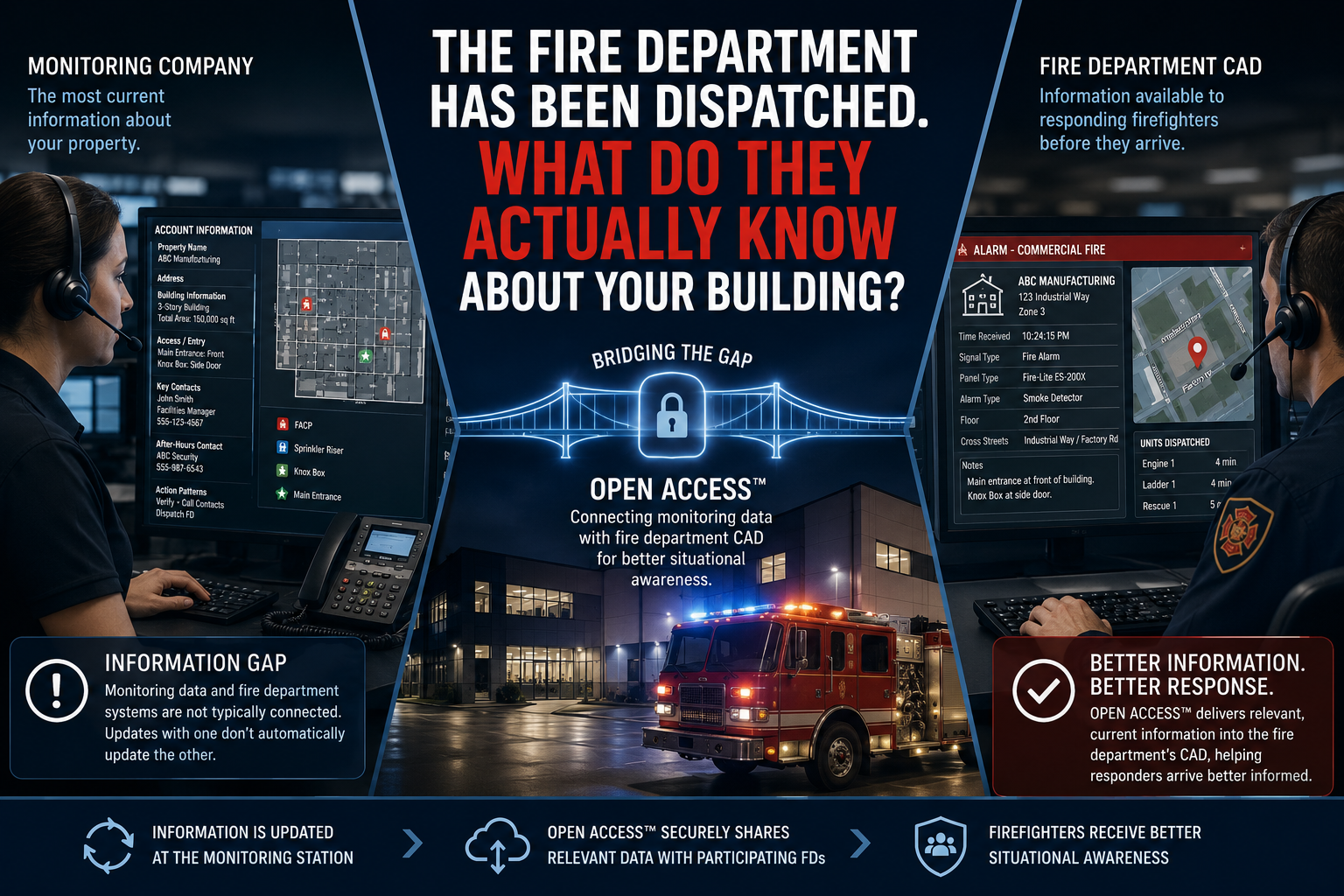
The Fire Department Has Been Dispatched. What Do They Actually Know About Your Building?
A fire alarm has activated at your facility. What is the relevant fire alarm monitoring information that is actually delivered to the fire department?
The signal reaches your monitoring station, the appropriate emergency communications centre is notified, and firefighters are dispatched.
They’re now on their way.
But what do they actually know about the building they’re responding to?
Many building owners may assume that the information maintained by their alarm monitoring company is also readily available to their local fire department.
Traditionally, that isn’t necessarily the case.
Your alarm monitoring company and the fire department’s Computer-Aided Dispatch (CAD) system operate in separate information environments. Updating information with one organization does not automatically mean the other has received the same update.
That creates an information gap at exactly the time when information can be most valuable.
Two Systems, Two Sets of Information
Consider how often information about a commercial property can change.
Building contacts change. Property managers change. Access instructions change. Businesses renovate, expand or change how portions of their facilities are used.
Customers are encouraged to keep this information current with their alarm monitoring company because the monitoring station interacts with their account whenever signals are received.
At Fire Monitoring of Canada (FMC), for example, we regularly remind customers to review and update their account information, contact lists and action patterns.
But updating information with your monitoring company does not automatically update the information available to your local fire department.
The fire department maintains information within its own systems, including its Computer-Aided Dispatch system. Traditionally, there has not been a direct connection keeping the information maintained by the monitoring company and the information available within fire department systems synchronized.
As a result, two organizations involved in responding to the same emergency can potentially be working with different sets of information.
What Happens When the Alarm Is Dispatched?
When a fire alarm signal is received at a monitoring station, trained operators follow established procedures to notify the appropriate emergency communications centre and initiate the required response.
The fire department can then dispatch resources to the property.
But traditional alarm notification provides only part of the information that may exist about that monitored property.
The monitoring company may have additional information associated with the account that has been provided or updated by the customer.
Historically, getting that information from the monitoring environment into the hands of responding firefighters has not been seamless.
The systems were simply not designed to communicate that way.
The Information Gap
This isn’t necessarily a failure by the monitoring company or the fire department.
It’s an interoperability problem.
Monitoring stations maintain their systems for the purpose of receiving and responding to alarm signals.
Fire departments maintain CAD and other operational systems for managing emergency responses.
Both systems serve important purposes, but traditionally they operate independently.
That means information provided to one does not automatically flow to the other.
In an era when information can move around the world almost instantly, that raises an important question:
Can we do a better job of connecting the information already available at the monitoring station with the firefighters responding to the emergency?
We believe the answer is yes.
Bridging the Gap With OPEN ACCESS™
FMC developed OPEN ACCESS™ to help bridge the information gap between the alarm monitoring industry and the fire service.
Rather than treating the monitoring station and the fire department as two completely separate information environments, OPEN ACCESS™ creates a connection that allows participating fire departments to access relevant information associated with monitored properties.
This represents an important change in how we think about alarm monitoring.
The monitoring station doesn’t simply have to be the place where an alarm signal stops before a dispatch begins.
It can become part of a connected information ecosystem.
Connecting Monitoring Data With Fire Department CAD
One of the most important opportunities created by OPEN ACCESS™ is the ability to connect monitoring information with the systems fire departments already use to manage emergency responses.
For many departments, that system is their Computer-Aided Dispatch, or CAD, platform.
CAD is central to how emergency calls are received, managed and dispatched. It helps communications personnel and responding crews understand where they’re going and what type of incident they’re responding to.
OPEN ACCESS™ can help bridge FMC’s monitoring data and a participating fire department’s operational environment, including integrations with CAD where supported.
The goal isn’t to replace the fire department’s systems.
It’s to make relevant information from the monitoring environment more accessible within the fire department’s existing workflow.
That distinction is important.
Firefighters shouldn’t have to become alarm monitoring operators, and dispatchers shouldn’t have to search through unrelated systems for information.
The technology should help bring useful information closer to the people who need it.
Why Current Information Matters
This also reinforces something we regularly tell our customers:
Keeping your monitoring information current matters.
The value of any information system depends on the quality of the information inside it.
If your property manager changes, tell us.
If important building information changes, tell us.
If your emergency contacts or response instructions change, tell us.
The monitoring station may interact with your account much more frequently than the fire department interacts directly with your building information. That creates an opportunity for the monitoring company to maintain a current source of customer-provided information.
OPEN ACCESS™ can then help make appropriate information more accessible to participating fire departments when it is needed.
Better Information Can Mean Better Situational Awareness
When firefighters respond to an alarm, they’re heading toward a situation that may still be developing.
Before arriving, every useful piece of information can contribute to their understanding of the incident.
- Where are they going?
- What type of signal has been received?
- What information is available about the property?
- Has something relevant changed since information about the building was last recorded elsewhere?
Technology cannot replace firefighter training, experience or established emergency response procedures.
But technology can help provide responders with better information.
And better information can contribute to better situational awareness.
Connecting the Life Safety Ecosystem
For decades, the alarm monitoring industry and the fire service have performed different but connected roles.
The monitoring station receives the signal.
The emergency communications centre receives the notification.
The fire department responds.
The building owner maintains the property and provides information about it.
Each participant is part of the same life safety ecosystem, yet the technology connecting them has not always reflected that reality.
OPEN ACCESS™ is about changing that.
By helping connect alarm monitoring information with participating fire departments and their operational systems, we can begin closing an information gap that has existed for years.
Because the question shouldn’t simply be:
How quickly was the fire department dispatched?
We should also be asking:
What information did we give them before they arrived?
At Fire Monitoring of Canada, we believe the future of fire alarm monitoring isn’t just about transmitting signals faster.
It’s about getting the right information to the right people at the right time.