Your Fire Alarm Passed Inspection. But Will Your Building Respond Correctly?
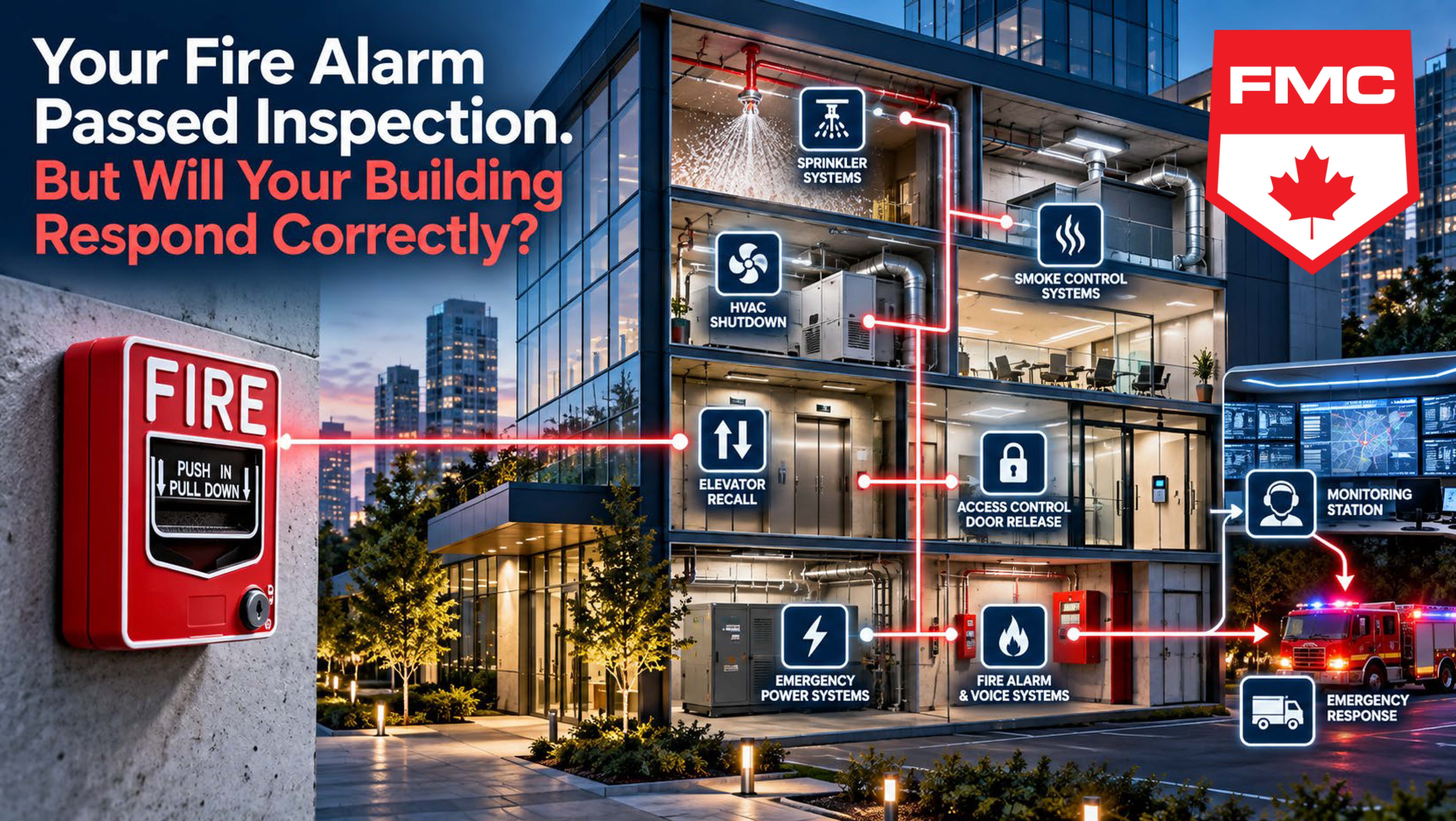
Your Fire Alarm Passed Inspection. But Will Your Building Respond Correctly?
A fire alarm technician completes an annual inspection.
The fire alarm panel operates correctly. Detectors respond. Pull stations activate. Signals are received. The report is completed.
Everything is working.
Or is it?
In today’s buildings, the fire alarm system rarely operates entirely on its own.
During an emergency, a fire alarm may initiate a series of events throughout the building. Elevators may need to recall. Magnetic door holders may release. Smoke control systems may activate. HVAC equipment may shut down or change operation. Access-controlled doors may need to respond. Emergency generators may become involved. Signals may need to reach the monitoring station.
Each individual system could be functioning perfectly.
But there is another important question:
Do they work together?
That question has become increasingly important in Ontario with changes to the Ontario Fire Code that came into effect January 1, 2026.
A Significant Change to Ontario’s Fire Code
Ontario’s updated Fire Code introduced a new Section 6.10 addressing integrated fire protection and life-safety systems.
The requirements apply specifically to integrated fire protection and life-safety systems installed on or after January 1, 2020 that were required by the Ontario Building Code to be verified in accordance with CAN/ULC-S1001.
For those systems, the Fire Code now requires the interconnections between fire protection and life-safety systems to be tested and maintained in accordance with CAN/ULC-S1001.
That distinction is important.
This isn’t a new requirement suddenly applying S1001 to every existing building in Ontario.
Instead, it addresses something that makes a great deal of sense:
If a building was designed and commissioned with integrated life-safety systems that were required to work together, we need to make sure those integrations continue to work throughout the building’s life.
What Is Integrated Systems Testing?
Think about a relatively simple fire alarm sequence.
A smoke detector activates on an upper floor of a commercial building.
The fire alarm panel receives the signal.
But that may only be the beginning.
Depending on the building’s design, that single event could trigger responses from multiple systems:
- Fire alarm and voice communication systems
- Elevator recall
- Smoke control systems
- HVAC shutdown or control sequences
- Fire and smoke dampers
- Magnetic door holders
- Access control systems
- Emergency power systems
- Sprinkler and fire pump systems
- Fire shutters or other building systems
Individually inspecting those systems doesn’t necessarily demonstrate that the entire sequence will happen correctly.
That’s where integrated systems testing comes in.
CAN/ULC-S1001 looks at the building’s integrated fire protection and life-safety systems as a whole to verify that the required interconnections and sequences operate as intended.
It’s the difference between asking:
“Does this system work?”
and:
“When this happens, does everything that is supposed to happen next actually happen?”
That’s a very different question.
S536, S537, S1001 and S561: What’s the Difference?
These standards can understandably become confusing for building owners and property managers.
A simplified way to think about them is:
CAN/ULC-S536 – Inspection and Testing
Is the fire alarm system continuing to operate and be maintained as required?
CAN/ULC-S537 – Verification
When a fire alarm system is installed or certain work is performed on it, has the system or affected portion been properly verified?
CAN/ULC-S1001 – Integrated Systems Testing
Where fire protection and life-safety systems are required to interact, do those systems operate together according to the building’s required sequences?
CAN/ULC-S561 – Fire Signal Monitoring
Where applicable, does the installation and service used to transmit fire alarm signals to the fire signal receiving centre meet the applicable requirements for fire signal monitoring?
These standards address different pieces of the life-safety chain.
One should not be viewed as a replacement for another.
The Building Changes After Construction
This may be the most important part of the conversation.
Buildings don’t remain frozen in time after they are commissioned.
Tenants change.
Spaces are renovated.
Access control systems are upgraded.
Elevators are modernized.
HVAC equipment is replaced.
Fire alarm systems are expanded.
Software gets updated.
Building automation systems change.
New security systems are installed.
Contractors come and go.
Over years of operation, a building can undergo dozens or even hundreds of changes.
And every change creates an important question:
Did we affect one of the building’s life-safety sequences?
A door that released correctly when the building opened may now be connected to a newer access control system.
An HVAC sequence that worked during commissioning may have been affected by a building automation upgrade.
An elevator controller may have been modernized.
A fire alarm panel may have been replaced or expanded.
Each contractor may correctly complete the work within their own scope.
But somebody still needs to consider the building as a complete life-safety system.
This Is Bigger Than the Fire Alarm Panel
At Fire Monitoring of Canada, we have spent decades working with fire alarm systems.
But modern life safety requires us to think beyond the panel.
A fire alarm system can detect an emergency and initiate the correct output, but if another system doesn’t respond appropriately, the intended life-safety sequence may not be completed.
That is why coordination between stakeholders is becoming increasingly important.
- Fire alarm companies
- Electrical contractors
- Elevator contractors
- Mechanical contractors
- Building automation providers
- Security and access control integrators
- Monitoring companies
- Property managers
- Building owners
- Fire protection professionals
Everyone may own a different piece of the system.
The building owner ultimately needs all of those pieces to work together.
Monitoring Is Part of the Life-Safety Chain
There is another connection that is particularly important from FMC’s perspective.
Where a fire alarm system is required to be monitored, the Ontario Fire Code places responsibility on the building owner to ensure continuation of that monitoring. Where central-station monitoring is used, the owner must obtain documentation demonstrating that the monitoring service complies with the applicable NFPA 71 or CAN/ULC-S561 requirements.
That means the life-safety sequence doesn’t necessarily end at the property line.
When a fire alarm occurs, information may need to travel through an entire chain:
Detection → Fire Alarm System → Communication System → Monitoring Station → Emergency Response
Every part of that chain matters.
Testing the initiating device is important.
Testing the fire alarm panel is important.
Testing the building’s integrated responses is important.
And ensuring the alarm signal reliably reaches the monitoring infrastructure is important.
Life safety isn’t one device. It’s a system of systems.
What Should Ontario Building Owners Be Asking?
The new requirements create an opportunity for property managers and building owners to better understand how their buildings actually operate during an emergency.
Some useful questions include:
- Was our building’s integrated life-safety system installed on or after January 1, 2020?
- Was CAN/ULC-S1001 integrated systems testing required when the building or system was constructed?
- Do we have the original integrated testing documentation?
- What systems are expected to respond when the fire alarm activates?
- Have any of those systems been modified since the original testing?
- Who is responsible for coordinating the required integrated testing?
- Are integrated testing records being properly retained?
- Does our fire alarm monitoring continue to meet the applicable requirements?
If you don’t know the answers, that doesn’t necessarily mean something is wrong.
But they’re increasingly important questions to ask.
From Individual Systems to Complete Building Life Safety
For decades, the fire protection industry has understandably focused on individual systems.
Is the sprinkler system working?
Is the fire alarm working?
Is the fire pump working?
Is the monitoring working?
Those questions remain critical.
But increasingly, we need to add one more:
Does the building work?
Ontario’s new integrated systems testing requirements reinforce an important principle for our industry.
A collection of compliant components does not automatically guarantee a successful integrated response.
Life-safety systems need to be designed properly.
They need to be installed properly.
They need to be monitored where required.
They need to be inspected and maintained.
And when those systems are intended to interact, we need confidence that they will continue to work together when they’re needed most.
At Fire Monitoring of Canada, we believe that is where the industry needs to continue heading.
Not simply testing individual devices.
Not simply checking boxes.
But understanding the entire life-safety chain — from the first detection of an emergency to the response that follows.