When Did You Last Update Your Alarm Monitoring Contact List?
When Did You Last Update Your Alarm Monitoring Contact List?
When an alarm signal reaches a monitoring station, every second matters. That’s why keeping your alarm monitoring contact list current is such an integral component to your building’s life safety plan.
Our operators need to quickly understand what has happened, follow the appropriate response procedures and contact the people responsible for the property.
But there is one important part of that process that your monitoring company cannot control:
Whether the contact information and instructions on your account are still accurate.
At Fire Monitoring of Canada (FMC), we work hard to make sure alarm signals are handled quickly and according to the instructions associated with each account. But effective monitoring is a partnership. We rely on our customers to tell us when their people, phone numbers, schedules or response instructions change.
If we don’t know something has changed, our monitoring team may be working with outdated information when it matters most.
Your Contact List Is Part of Your Life Safety System
It can be easy to think of an alarm monitoring contact list as administrative information.
It isn’t.
Consider what can happen over the course of a year:
- An employee leaves the company.
- A new facilities manager takes responsibility for the building.
- Someone changes their mobile number.
- An employee is promoted or changes roles.
- An after-hours contact is no longer available.
- Your business changes its operating hours.
- Weekend operations change.
- A property management company changes.
- Different people become responsible for different types of alarm signals.
Your fire alarm, sprinkler, security and supervisory systems may be operating exactly as intended, but when a signal reaches the monitoring station, our operators need to know what you want us to do next.
That’s where your contact list and action patterns become extremely important.
What Is an Action Pattern?
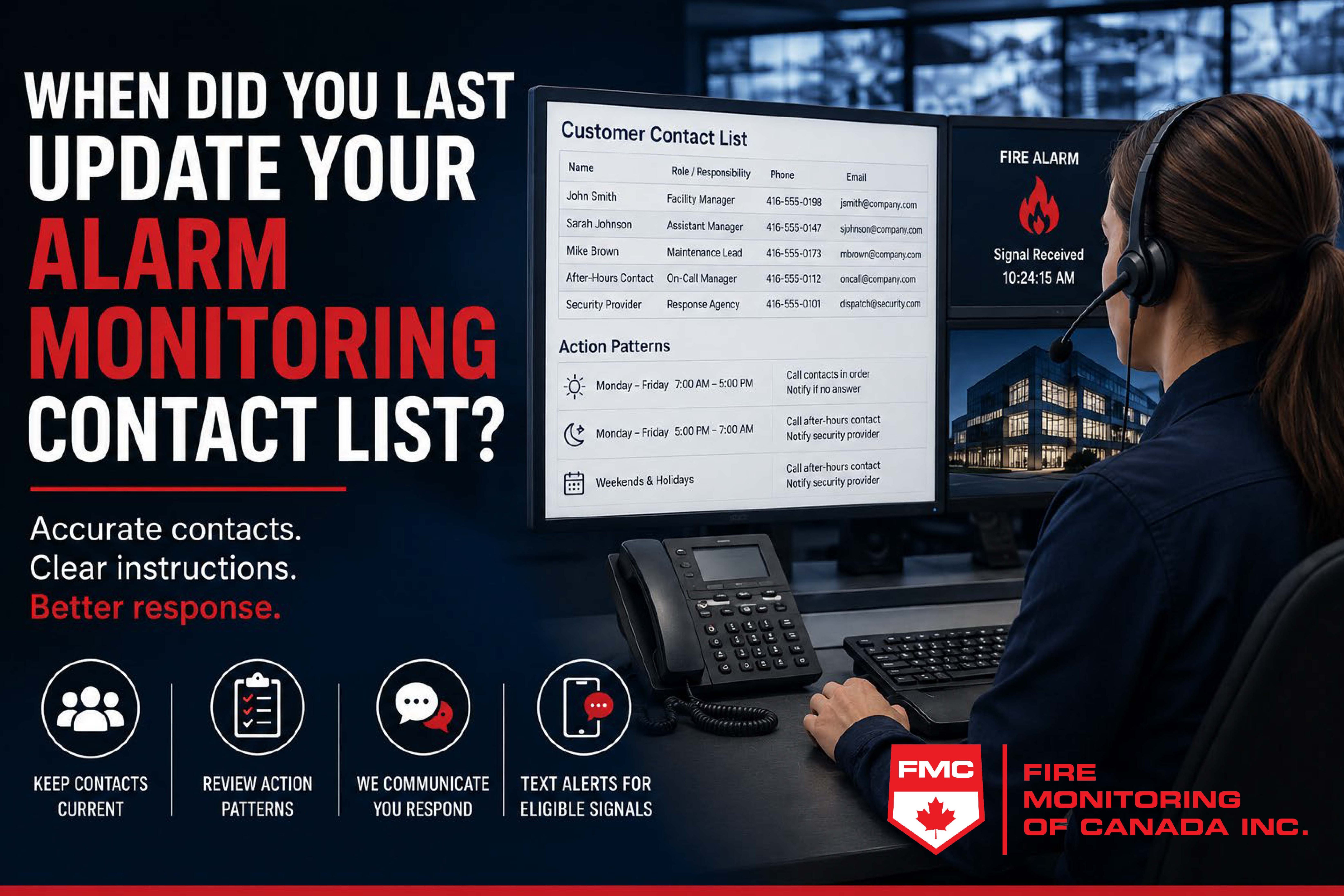
An action pattern provides our monitoring team with instructions for handling specific signals from your property.
Those instructions can vary depending on several factors, including the type of signal, the day of the week and the time of day.
For example, the appropriate response to a signal at 2:00 p.m. on a Tuesday may be different from the response required at 2:00 a.m. on a Sunday.
Your organization’s needs can also change over time.
That’s why reviewing your monitoring information shouldn’t simply mean checking that the phone numbers are correct. It’s also an opportunity to ask:
Do the instructions we gave our monitoring company still reflect how our organization operates today?
We Can Only Work With the Information We Have
When an alarm occurs, FMC’s monitoring team will do its best to reach the appropriate responsible parties and follow the instructions associated with the account.
But we’re ultimately dependent on the information our customers provide to us.
If the first person on the contact list left the organization six months ago and we weren’t notified, our operator has no way of knowing that until we attempt to contact them.
If your overnight manager changed, we need to know.
If your weekend hours changed, we need to know.
If you want different people contacted for particular types of signals, we need to know.
Keeping this information current helps our monitoring operators do their jobs more effectively and helps your organization receive the response it expects.
FMC Helps You Remember
We understand that updating an alarm monitoring contact list isn’t something most businesses think about every day.
That’s why FMC provides reminders to our customers.
We include prompts with our invoices encouraging customers to review their contact lists and action patterns and notify us of any necessary changes.
We’ve also made it easy to communicate updates to our team, including convenient email options for submitting changes.
The goal is simple: make it as easy as possible for our customers to keep the information we rely on current.
Text Messaging Is Changing Alarm Communication
Communication between monitoring stations and customers is also evolving.
FMC now offers text notifications for eligible alarm signals.
Where permitted under applicable ULC requirements, customers can receive notifications and acknowledge many types of signals through text messaging rather than requiring a traditional telephone conversation.
There are important exceptions.
Fire alarm signals still require telephone call procedures and must be handled according to the applicable requirements.
However, for many other eligible signals, text communication can provide customers with a convenient way to receive information and acknowledge signals.
It’s another way we’re working to make communication between our monitoring centre and our customers faster and easier while continuing to meet applicable monitoring requirements.
When Should You Review Your Contact List?
At a minimum, reviewing your monitoring information should become part of your organization’s regular life safety procedures.
You should also contact FMC whenever there is a significant change involving:
- Employees or managers responsible for the property
- Phone numbers or email addresses
- Building ownership or property management
- Business hours
- After-hours responsibilities
- Weekend or holiday operations
- Emergency response procedures
- People authorized to make decisions regarding the alarm system
Don’t wait until an alarm occurs to discover that something is outdated.
Monitoring Is a Partnership
Technology plays an increasingly important role in modern alarm monitoring. Faster communications, redundant transmission paths, text notifications and improved connections between monitoring centres and emergency responders can all help improve the process.
But technology can’t determine that the facilities manager listed on an account left the company eight months ago.
That requires communication.
At FMC, our responsibility is to monitor your systems and respond to the signals we receive according to the instructions associated with your account.
We ask our customers to help us by making sure those instructions—and the people we’re supposed to contact—remain accurate.
Take a few minutes today and ask yourself:
When did we last review our alarm monitoring contact list?
If you can’t remember, now is probably a good time.
Contact Fire Monitoring of Canada to review your contact list, action patterns and available notification options, including text notifications for eligible signals.