Why You Should Request a CCTV Coverage Diagram Before Install
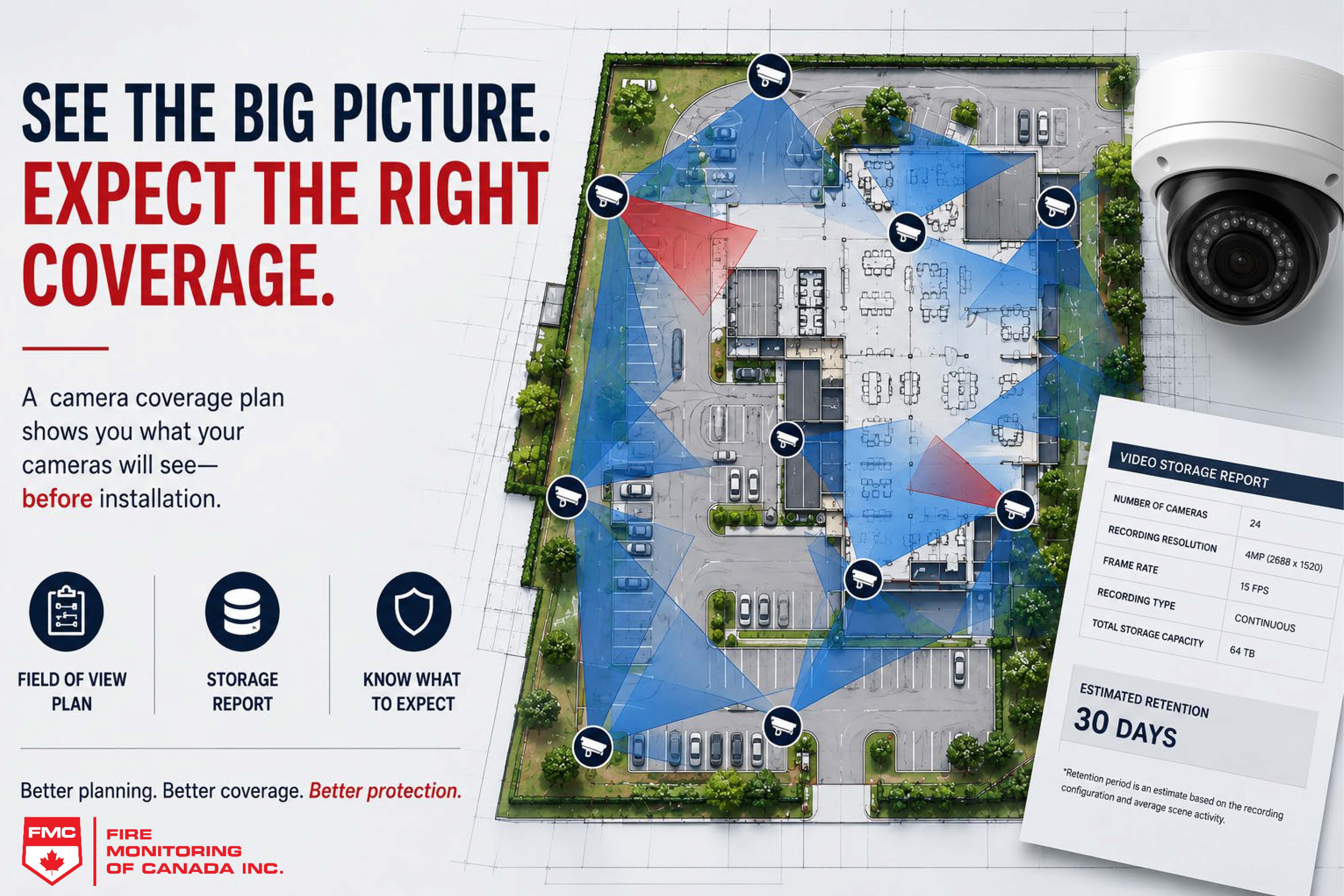
Why Every Camera System Should Come with a Coverage Plan
When most businesses purchase a video surveillance system, they tend to focus on the cameras themselves:
resolution, artificial intelligence, night vision, mobile access, and other advanced features.
While those capabilities are important, there is another question that may be even more critical:
What Will My Cameras Actually See?
Surprisingly, many organizations do not know the answer until after their system has already been installed.
By that point, correcting blind spots, changing camera locations, or improving image detail may require additional equipment, labour, and expense.
How could that have been avoided?
Simply by asking your security integrator to provide a camera coverage (field-of-view) diagram
before issuing the purchase order. Reviewing the proposed camera coverage in advance allows you to understand
exactly what your surveillance system is expected to capture and helps ensure there are no surprises once the
installation is complete.
A Camera Does Not See Everything
One of the biggest misconceptions about video surveillance is that a single camera can monitor an entire parking
lot, warehouse, office or retail space in perfect detail.
Every camera has a defined field of view. The wider the viewing angle, the more area the camera can cover.
However, wider coverage may also reduce the amount of usable detail available at greater distances.
For example:
- A person may be visible walking through the scene, but their face may not be identifiable.
- A vehicle may be recorded, but its licence plate may not be readable.
- An incident may occur near the edge of the image where important details are difficult to distinguish.
- A critical doorway, aisle or asset may fall just outside the camera’s field of view.
These situations are not always equipment failures. In many cases, they are the result of inadequate planning
before installation.
Ask for a Camera Coverage Diagram
Before approving a camera system, ask your security integrator to provide a camera coverage diagram, also known as a field-of-view plan.
This drawing should clearly identify:
- Every proposed camera location
- The direction each camera will face
- The approximate viewing angle of each camera
- Expected areas of coverage
- Areas where camera views overlap
- Potential blind spots or limitations
- The entrances, exits, assets and activity areas each camera is intended to monitor
A properly prepared field-of-view plan allows the end user, integrator and other project stakeholders to review
the expected coverage before installation begins.
It is much easier and less expensive to adjust a camera location on a drawing than it is to relocate a camera
after cabling, conduit and mounting hardware have already been installed.
Every Camera Should Have a Defined Purpose
A well-designed surveillance system does more than place cameras around a building. Every camera should have a
clearly defined purpose.
A camera may be intended to:
- Identify people entering or leaving a building
- Provide an overview of a parking lot or warehouse
- Capture licence plates at a controlled vehicle entrance
- Monitor cash-handling or transaction areas
- Observe loading docks and delivery areas
- Protect high-value inventory or equipment
- Monitor emergency exits or restricted areas
- Support investigations following an incident
These objectives require different camera locations, lenses, mounting heights and image-detail levels.
A camera designed to provide a general overview may not provide the detail required to identify a person’s face
or read a licence plate.
Defining the purpose of each camera before installation helps ensure the final system supports the customer’s
actual security objectives.
Understand the Difference Between Detection and Identification
Seeing activity on a screen does not necessarily mean the recorded image will provide enough detail for an
investigation.
A camera may allow an operator to:
- Detect that a person or vehicle is present
- Observe general activity or movement
- Recognize a familiar person or vehicle
- Identify an unknown person with sufficient clarity
Each of these outcomes requires a different level of image detail. Distance from the camera, lighting,
resolution, lens selection, camera angle and mounting height can all affect whether the image is useful.
Your integrator should explain what level of detail can reasonably be expected in each important area of the site.
Do Not Forget About Video Storage
Camera coverage is only one part of an effective surveillance system.
The other important question is:
How long will the recorded video remain available?
Many organizations assume their footage will be stored for weeks or months. After an incident, they may discover
that the required video has already been overwritten because the system did not have enough storage capacity.
The expected retention period is influenced by several factors, including:
- The number of cameras
- The resolution of each camera
- The selected frame rate
- The recording quality and compression settings
- Whether cameras record continuously or only when motion is detected
- The amount of activity within each camera’s view
- The available hard-drive or cloud-storage capacity
Ask for a Video Storage Report
Your integrator should provide a written storage calculation or retention report before the system is installed.
The report should outline:
- The number of cameras included in the calculation
- The recording resolution and frame rate
- The recording method for each camera
- The total available storage capacity
- The estimated number of days of video retention
- When older footage is expected to be overwritten
- Any assumptions used to calculate the estimated retention period
Storage estimates can vary depending on the amount of motion and activity at the site, but a professionally
prepared report provides a realistic expectation of how the system should perform.
The desired retention period should also be discussed before installation. Some organizations may only require
a few weeks of footage, while others may have contractual, insurance, operational or regulatory requirements
that call for longer retention.
Design the System Before Installing It
A professionally designed camera system begins long before the first camera is mounted.
Proper planning helps ensure:
- Critical areas receive appropriate coverage
- Potential blind spots are identified early
- Each camera has a defined purpose
- The expected image detail matches the customer’s needs
- Storage capacity supports the required retention period
- The system can be expanded more easily in the future
- Customer expectations match the system’s real-world capabilities
Without this planning, an organization may invest in a system that records video but fails to capture the
information needed when an incident occurs.
Questions to Ask Your Security Integrator
Before approving a surveillance system, consider asking the following questions:
- Can you provide a field-of-view diagram showing the expected coverage?
- What is the intended purpose of each camera?
- Which areas may still have limited coverage or blind spots?
- Will the cameras provide overview, recognition or identification-level detail?
- How will lighting conditions affect image quality during the day and at night?
- How many days of recorded video should we expect?
- What assumptions were used in the storage calculation?
- Will changing the recording quality or frame rate affect the retention period?
- How easily can the system be expanded in the future?
A knowledgeable integrator should be able to answer these questions clearly and document the proposed system’s
expected performance.
The FMC Difference
At Fire Monitoring of Canada Inc. (FMC), we believe customers should understand exactly what
they are investing in before their camera system is installed.
That is why FMC provides a detailed schematic showing the proposed camera locations, viewing directions and
anticipated fields of view throughout the site.
This allows our customers to review what each camera is expected to capture, understand potential limitations
and confirm that the design supports their security objectives.
We also provide storage calculations that outline the expected video-retention period based on the proposed
camera count, recording settings and available storage capacity.
Our goal is simple: to eliminate surprises and ensure our customers know what their cameras are expected to see
and how long their recorded footage should remain available.
Because when an incident occurs, the value of a surveillance system is not determined by the number of cameras
installed. It is determined by whether the system captured the information you needed.
“`